Frederick D. Jones Jr.
Frederick D. Jones Jr. (1923-1996) was a significant figure in the development of the African American art tradition and culture on Chicago’s South Side during the 1930s and 1940s.
Jones grew up in Georgetown, South Carolina, a seaport town where he first encountered artists working by the water. Watching them depict a large schooner inspired his interest in becoming an artist. When his family relocated to Atlanta, Jones met Hale Woodruff, an artist and teacher at Atlanta University, who encouraged him to pursue the arts.
While living and working in Atlanta, Jones took a janitorial position at Coca Cola. A co-worker had mentioned that Harrison Jones, the chairman of the board of directors, was a patron of the arts and offered to show him Frederick’s work. Harrison Jones’ support enabled Federick to attend a local art school in Atlanta and later continue his education at the Chicago Art Institute, where he studied painting under Louis Ritman.
After graduating in 1947, Jones became the Assistant Director of the South Side Community Art Center where he had a significant impact on Chicago's Black art scene. He participated in the Artists of Chicago and Vicinity exhibitions and sold work at the 57th Street Art Fair. Music, spirituality, and surrealism, play key roles in Jones’ work, reflecting both the South Side art scene and the influence of his relationships with Eldzier Cortor (1916-2015) and Charles White (1918-1979). Today, Jones’ art held in the collections of the National Gallery of Art, the Minnesota Museum of American Art, and The Johnson Collection.
Frederick D. Jones, Jr. (1913-1996)
Benny Goodman, c. 1940
ink on paper
17 × 13 inches
The Fine Art of [Frederick D. Jones Jr.] // 08.28.2024
Frederick D. Jones, Jr. (1913-1996)
Benny Goodman, c. 1940
ink on paper
17 × 13 inches
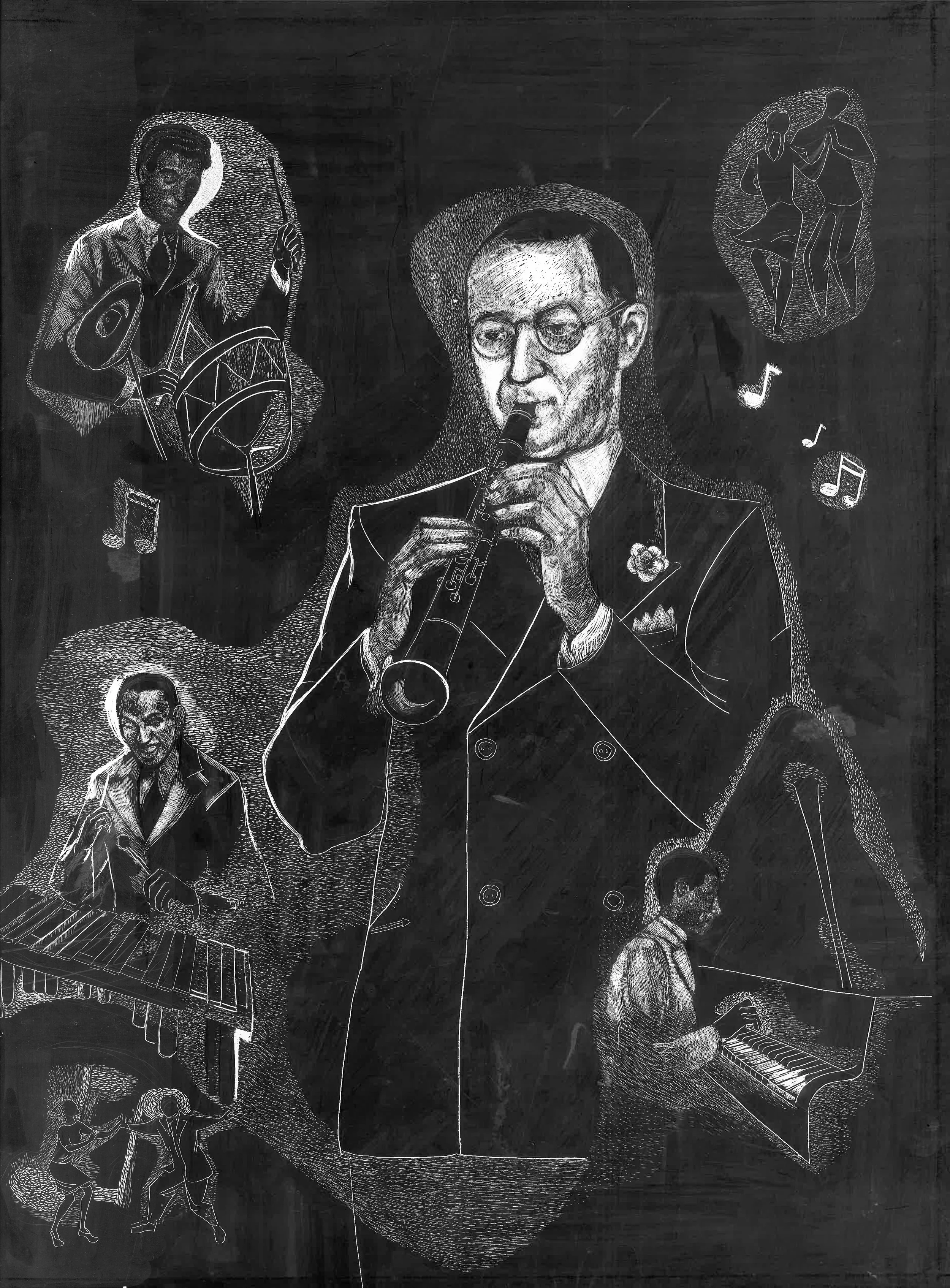
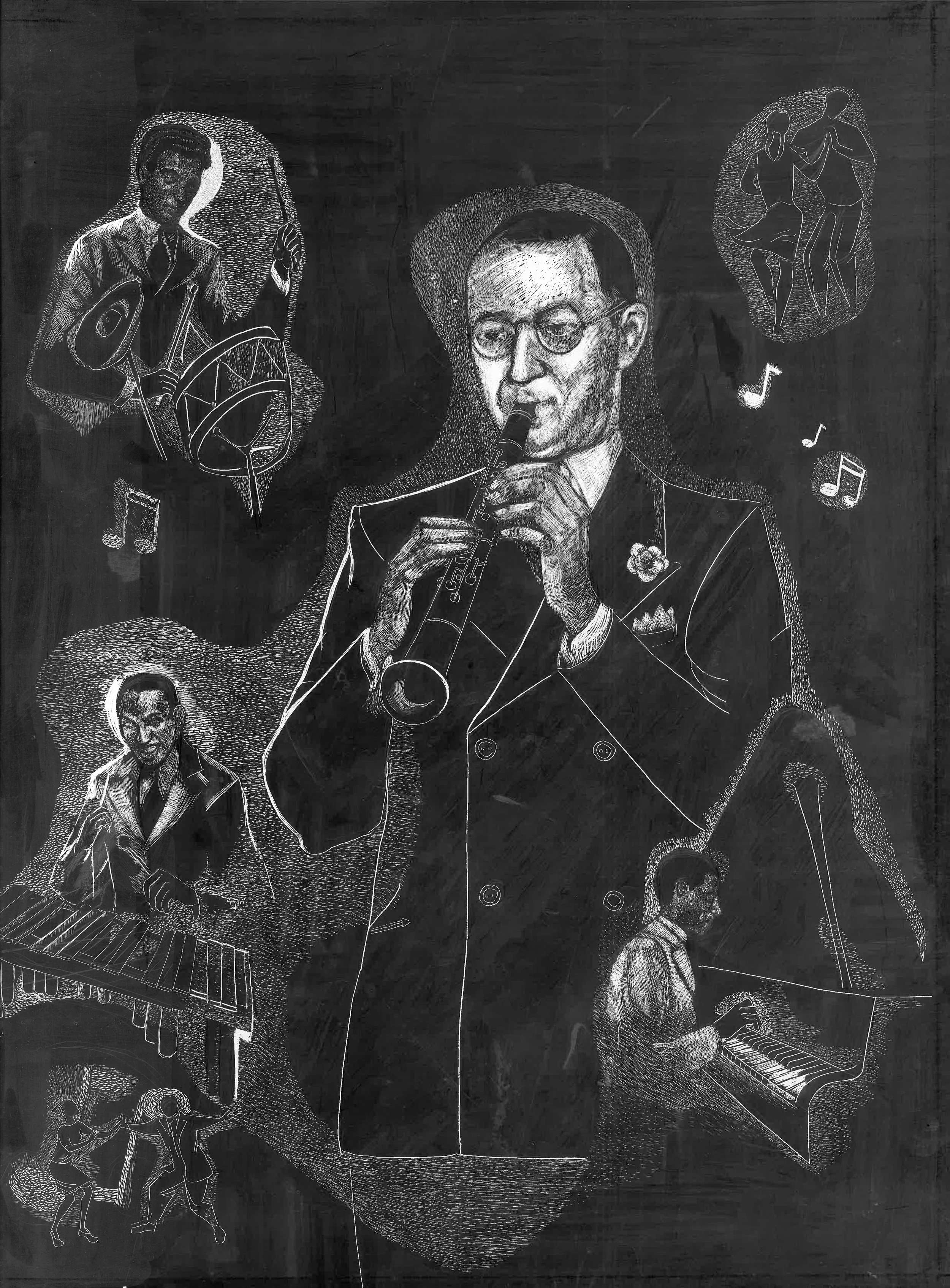
The color palette of Benny Goodman is simplistic, with layers of black ink creating depth and space, while the rendering of white staccato lines creates an atmosphere full of action. Centered in the foreground with his clarinet, Benny Goodman is surrounded by members of his band – all the musicians are absorbed in the act of playing music for an audience visibly dancing in the background. This pen and ink drawing, by Chicago artist Frederick D. Jones Jr. (1923-1996), is part of a series of drawings Jones created depicting famous jazz musicians of the era. Benny Goodman, son of Russian-immigrant Jews, was a Chicago musician known as “The King of Swing” and considered one of the best Clarinetists of all time. Goodman’s quartet band as of 1936 and depicted in the drawing above included, Gene Krupa (1909-1973) on drums, Teddy Wilson (1912-1986) on piano, and Lionel Hampton (1908-2002) on vibraphone. First established as a trio (before Lionel Hampton joined) in 1935, this group of musicians was one of the first racially integrated jazz bands to play in front of paying audiences.
Prolific during his career and recognized as a young talent, Jones has been overlooked in the cannon of art history. In the mid 1930s, Jones was a student at the Britt School of Art in Atlanta, Georgia while working part-time at the Coca-Cola factory as a janitor, when Harrison Jones, Coca-Cola’s chairman, accidentally found Jones’ sketchbook and insisted on sponsoring Jones’ move to Chicago and enrollment in the School of the Art Institute of Chicago. After graduating 1947, Jones settled in Bronzeville and became a member of the South Side Community Art Center, eventually serving as the organization’s assistant director. Jones was one of the many artists to contribute to the vibrant art and music scene taking place in Chicago’s South Side, becoming friends with fellow South Side Community Art Center artist Eldzier Cortor (1916-2015). Jones described his friendships at the South Side Community Art Center as: “sort of like a brotherhood…Everybody was learning from everybody.”
The drawing of Benny Goodman represents the classic collaboration of fine art and music. The drawing of these four men was created early in Jones’ career, around 1940, the same year Jones moved from Atlanta to Chicago. In 1988 Jones sat down with Arlene E. Williams, for the Archives of American Art African-American Artists in Chicago oral history project (1988-1989). Jones named artist Hale Woodruff (1900 -1980) as an early influence and mentor, stating that Woodruff “carried my world…he taught me a lot and was like a father...,”. As his work developed, Jones created a dreamy, romantic style of fantasy. Spirituality, abstraction, and music continued to be influences in Jones’ work. Jones told the Chicago Tribune in 1987: “Painting is a simple thing... Make it flamboyant and beautiful but tell the truth.” Jones’ drawing Benny Goodman is just that: simple, flamboyant, and beautiful.