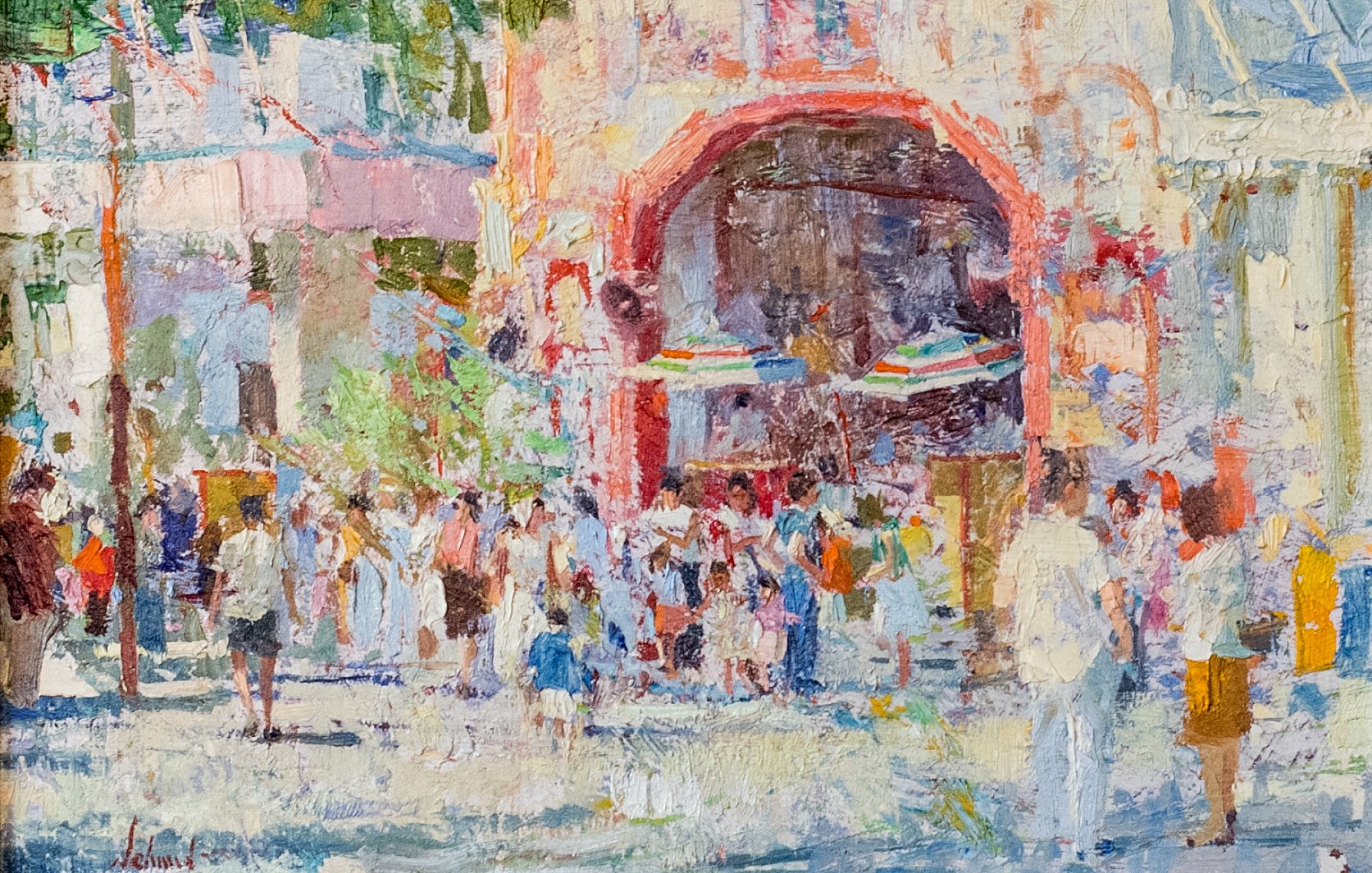
Richard Schmid (1934-2021), The Freak House, Riverview Park, Chicago,1965, Oil on Masonite, 8 x 12 inches
In the thick of Chicago winter, we often dream of the city’s summer months.
Richard Schmid’s painting transports us to a time when Chicago residents would spend these warm days and nights riding rollercoasters, eating hotdogs, and cozying up in the tunnel of love at Riverview Park. Positioned on the north branch of the Chicago River at Western and Belmont Avenues, this one hundred and forty-acre amusement park was a highlight of Chicago summers for 63 years, from its opening in 1904 until its unceremonious demise, bulldozed by the investment firm that bought the property, in October of 1967.
The Freak House, Riverview Park, Chicago, shows a crowd gathered before an attraction originally called the “Palace of Wonders,” which by Schmid's time had become the far less sensitive “Freak Show.” A historical photograph of the stage shows the same archway, with loudspeakers positioned on either side and podiums below, just as Schmid depicts them. In the painting, light bathes the building's facade in warm hues, as the figures at each podium are positioned under umbrellas, protecting them from the harsh summer sun. The crowd, still milling about before the stage, are just starting to gather, ready to be awed and intrigued by the sideshow performers. Two figures at right, a man and woman, stand clearly delineated, taking in the crowd.
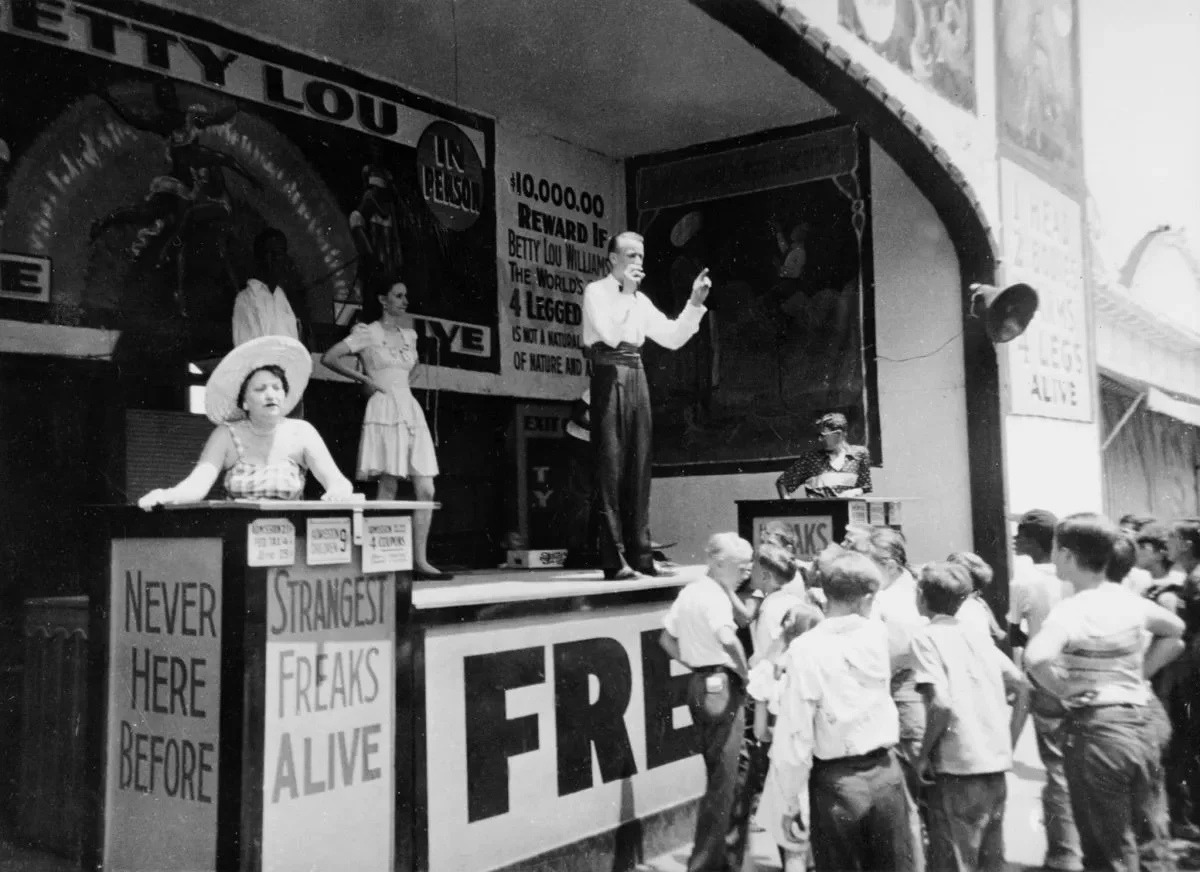
Marshall Brodien, center, is the talker-barker at the Riverview park Freak Show in the 1950s. Brodien, a trained magician, went on to play Wizzo the Wizard on the famous “Bozo Show.” Chicago Tribune
Schmid often painted from life, and in his bestselling primer on painting, Alla Prima II: Everything I Know About Painting—and More, writes that he “painted at Riverview as often as he could.” His plein air painting techniques are reflected in the canvases small scale and his application of paint. Loose brushwork, sometimes applied with a palette knife, produces a textured impression of the scene in bright, broken colors.
The park’s slogan, “Laugh Your Troubles Away,” speaks to the lighthearted play that give Chicagoans fond memories of the park to this day, but like so many amusement parks that popped up across the country following the Chicago World’s Columbian Exposition in 1893, and its Midway Plaisance, there was also a garish under side to the fun, seeped in bigotry and racism. Some Riverview attractions were an ugly reflection of period prejudices, such as “Frisco’s Underworld,” a walk through San Francisco’s Chinatown, or the dunk tanks that employed nearly all African-Americans, called the oh so politically correct, “Chocolate Drops.” Positioned on the main thoroughfare, right between the “Caterpillar” ride and “The Blue Streak” coaster, the “Freak Show” was a popular attraction at Riverview Park, often including a contortionist, sword swallower, and the most famous of the Riverview “freaks,” Betty Lou Williams (1932-1955), “the world’s only living four-legged girl.” A child born with her parasitic twin emerging from her abdomen, Williams was presented at carnivals and amusement parks as a human oddity, regularly appearing at Riverview in the early 1950s.
By the time Schmid painted this work, the property, which was once on the outskirts of the city, had become a site of urban development, and attendance to Riverview was in decline. The park occupies a nostalgic space for not just Chicagoans, but those who grew up riding the errant carney rides or attending sideshow amusements. The view Schmid offers us is detached from the crowd and stage; it's a sanitized perspective. Rather than contending with the park’s discriminatory underside, which by 1965, was starting to be called into question, Schmid’s interest is in technique and light, as it is in his acclaimed instructional text on direct painting, and many of his other works, often idealized landscapes and portraiture. The painting is a sunny day in the park, which only had two summers left, a mirage of people and architecture that would soon be gone.