|
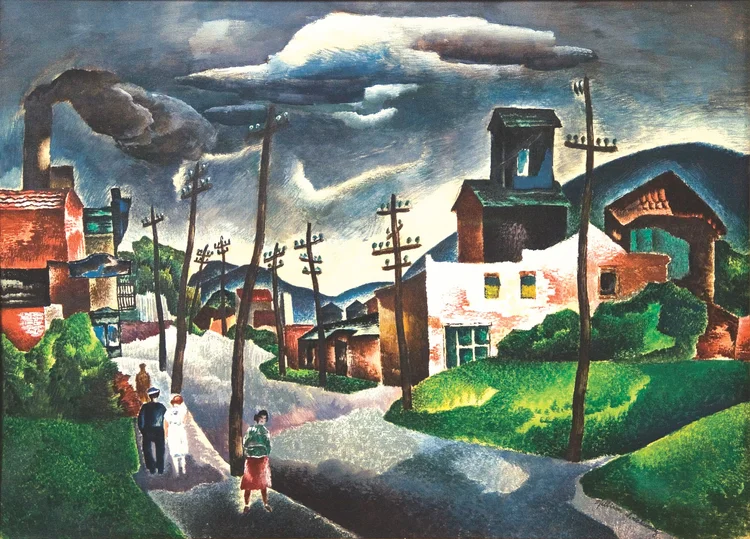
In 1930, William Schwartz began painting interpretations of music in abstract landscapes, which the artist called “Symphonic Forms,” while he simultaneously produced American Scene paintings depicting images of Chicago and the rural Midwest grounded in reality. In the second half of the decade, he was hired by the Works Progress Administration (WPA) under the New Deal to depict progress and industry in America. Between 1936 and 1938, Schwartz produced murals for three Illinois post offices, highlighting local progress and infrastructure, such as mining in Illinois and the Champ Clark Bridge over the Mississippi River. During this period, Schwartz traveled throughout Illinois, Michigan, and Wisconsin, painting rural towns, including at least four depictions of Galena, Illinois in both oil and gouache. In William S. Schwartz: Color and Coloratura by Madron Press, Alex Cornacchia concentrates on nature as the dominating force in Schwartz’s Galena, Illinois. While the tumultuous sky and rolling hills are prominent, the relationship between the natural environment and man-made elements is more ambiguous. Schwartz also emphasizes the rise of industry in the small town: smoke from a nearby plant mixes with the clouds, and tall, sinuous electric poles rise into the sky, dominating the composition. Schwartz’s focus likely reflects a New Deal agenda: rural electrification. In 1936, FDR introduced legislation for an economic initiative that would bring electric power to rural cities. The following year, Galena achieved a major milestone; a June 1937 article titled, “U.S. Grant’s Home Town Goes All-Electric,” celebrated Galena’s ability to now light, heat, and cook with electricity, allowing citizens to enjoy the convenience of modern appliances and reliable power. In the landscape, Schwartz clearly incorporates the rich colors, bulbous clouds, and other stylistic elements of the Spanish Mannerist painter, El Greco (1541-1614). Like the 16th century master’s View of Toledo, Schwartz’s clouds in Galena are defined by light breaking through—featured as a prominent white V-shaped line in the sky—while the cloud forms mirror the dark smoke emitting from the local smokestacks at left. Schwartz owned an extensive art library that included monographs of El Greco’s work and could visit the Art Institute of Chicago’s modest collection of the artist’s work, including the monumental Assumption of the Virgin, and The Feast in the House of Simon, which went on loan to the Art Institute in 1930. The influence of the latter work is evident in the rich reds and greens that appear in Galena, Illinois, as well as his dynamic play between light and brilliant color. Schwartz uses gouache to bring texture and detail to the architecture, likely responding to contemporary criticism that he often rendered forms with repetitive brushwork. Here, figures appear in minuscule form, while the buildings, land, and overall sense of progress dominate the scene.
|