|
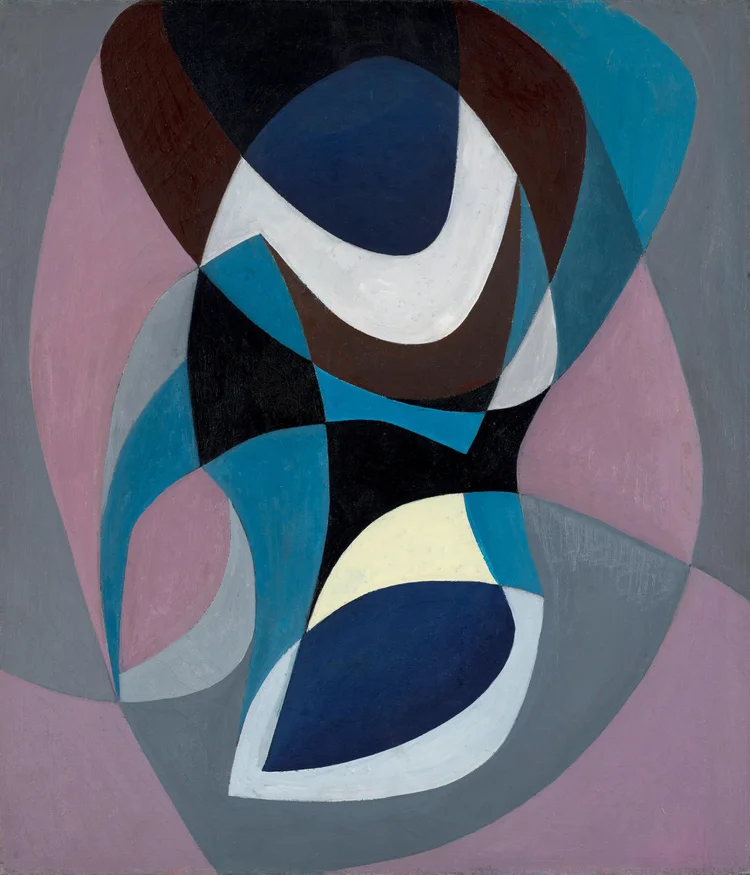
In 1927, Charles Green Shaw (1892-1974) sent his first novel to F. Scott Fitzgerald, seeking his honest feedback. After a lengthy pause, the latter finally wrote him a letter. Apologizing for the delay, Fitzgerald explained — sounding very much like man who’d read too many mediocre words in his lifetime — that he hadn’t had the highest expectations going in. “I was absolutely wrong,” Fitzgerald demurred. “It is a damn good piece of humorous writing from end to end.” Eight years later, way up in his little studio in the Drake Hotel on the corner of Park and 56th, Shaw had a near-identical experience with artist, critic, and modern art collector A. E. Gallatin. This time around, though, Shaw wasn’t looking for an appraisal of his writing: that was old hat for the Park Avenue polymath. In the intervening years, Shaw had taken up art under the tutelage of Thomas Hart Benton (who he didn’t care for) and George Luks (who he liked quite a bit), traipsed off to Paris and London to absorb all the European abstraction he could, then boomeranged back to the U. S. to become a full-fledged painter. Shaw’s portion of the Woolworth inheritance was surely a boon to these activities — when his New Yorker profiles and pieces about high society went out of style after the crash of ’29, Shaw’s high-wire transition into modern art came with the safety of an ample financial cushion. Still, he wanted to know: was he any good? So in 1935, A. E. Gallatin took a reluctant elevator ride up to Shaw’s studio. Like Fitzgerald, he’d seen a lot of bad art over the years and had developed a certain veneer of cynicism. By the time he left the Drake Hotel that day, though, he’d promised Shaw a solo show at the Gallery of Living Art (in some respects MoMA’s precursor as the first public museum in the U.S. devoted entirely to contemporary art). It would be the first time the space had ever been given over to the work of a single artist since its opening in 1927. Whether Untitled (Plastic Polygon Abstract Form), created the same year of that fateful studio visit, helped convince Gallatin of Shaw’s talent remains an open-ended question. But it is certainly representative of the work Shaw was doing at the time, one in a series of colorful, hard-edged geometric abstractions — the so-called “plastic polygons” — he'd begun in 1933. It was this series that would garner Shaw respect as an abstract artist, landing him in exhibitions alongside Alexander Calder and eventually up on the walls of the Guggenheim. Inherent in the forms is a compelling tension of play and seriousness — it’s just as easy to see the road being paved toward Shaw’s future children’s book illustrations as it is his ties to the shaped canvases of 1960s minimalism. Despite his well-regarded wordsmithery, Shaw didn’t make a habit of writing about his own art (“Once I pick up a pencil to write painting is way off,” he once told an interviewer). On the origin and evolution of the polygons there’s just one short essay in a 1938 issue of Plastique, though it packs a punch: “The polygon, sprouting, so to speak, from the steel and concrete of New York City, I feel to be essentially American in its roots,” he writes. “By a broader elimination I have sought to arrive at a greater purity.” Every polygon iteration, then, set out to distill itself even further, shaving off extraneous information to arrive at what Shaw termed an “aesthetic emotion.” Perhaps Chrysalis, a painting of his from 1935 with a palette and rhythm not too far off from Untitled (Plastic Polygon Abstract Form), is a wink at this idea, the title hinting not at straightforward transformation but a sort of metamorphosis in reverse, an intricate butterfly stepping back into its cocoon to emerge as a caterpillar, or an egg, or something so simple it can’t even be named yet, only felt. (For inquiries into Untitled (Plastic Polygon Abstract Form), pop over to this page.)
|